The kit
One goes out. One stays home and thinks.
The Companion plays the trip in your hand. The Station, on your desk, makes your world, opens what you bring home and keeps every mibi. The Caddy is the dock between them. We're building all three in the open.
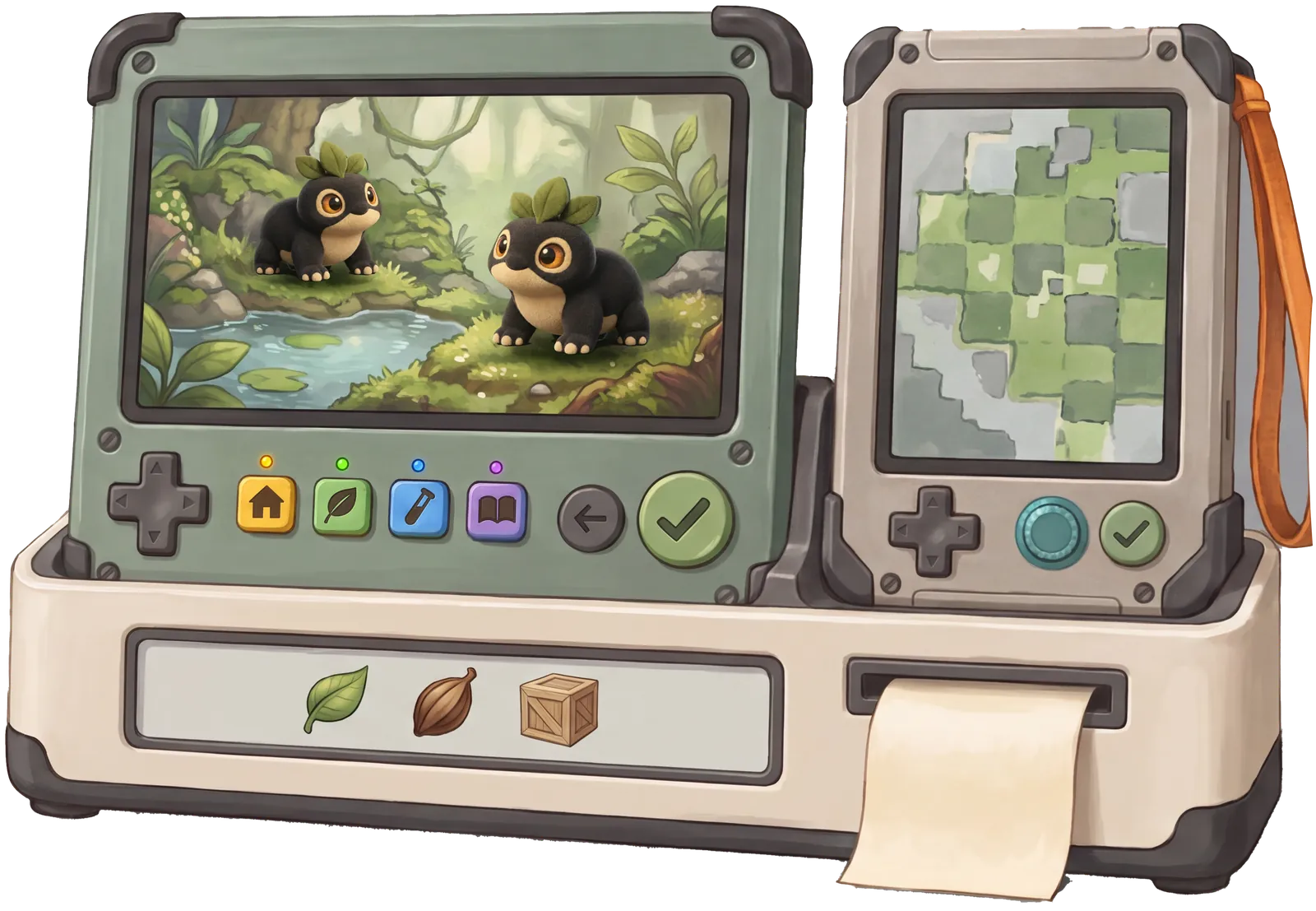
Why its own devices
Why not just an app?
Because the game lives in two places. A world you go out into, and a home that keeps going while you're away. A phone does both badly: it is never only out, and never always on.
- One job each
- The Companion plays the trip. The Station does the heavy work: making the world, drawing every mibi, opening crates. The Caddy keeps the archive.
- Always on
- The Station's screen stays on, with your vivarium living its own hours on the shelf.
- Keys
- A pad, ✓, ← and Call. The game is turn-based, so nothing needs quick fingers.
- Offline
- The kit plays fully offline, for good. Only the Station ever goes online, and only when you allow it, for updates. No account, ever.
Companion
Goes out with you, everywhere you go.
The Companion is the one in your hand on an expedition: the place, the mibis out with you, the pods underfoot. It plays the land the Station packed for it, and signs what happens out there.
- Screen
- 450 × 600colour, upright, 2.41 inches
- Keys
- A pad, ✓ and ←, and Call: it wakes the ground and hears what's buried.
- Power
- A battery, charged without wires while it sits in its cradle.
- Inside
- An ESP32-P4, with an ESP32-C6 for its radio.
Station
Stays home. Its vivarium keeps real hours.
Home is where you read your pods, grow them and live with your mibis. Its screen stays on, showing the collection and the vivarium. Hold it in two thumbs, or play it flat on the table.
- Screen
- 1024 × 600colour, 7 inches, wide
- Keys
- A pad, ✓ and ←, and four room keys: Home, Research, the Library and the Vivarium.
- Inside
- A Raspberry Pi 4. It makes your world, and draws every mibi from its kind's painted look and its own traits.
- Online
- The only device in the kit that ever is: outbound, and only when you allow it.
Caddy
Where the two meet, and where the crates cross.
It charges both handhelds, carries the crates across when you dock, keeps the archive of your mibis, and prints. Its little grey screen says what came home.
- Keeps
- Your mibis and their backups, on a card inside. It signs what is made at home.
- Screen
- 792 × 272e-paper, four greys. The picture stays with no power.
- Printer
- A 58 mm thermal printer, for a mibi's slip.
- Cradles
- Two, one shaped for each handheld, each with a seat sensor and a soft lamp.
Side by side
Three screens, to scale.
The hand-off
Seat the Companion, and all three answer.
The trip comes home as one moment. The Caddy feels the Companion land, lights its cradle and tells the Station, in about half a second.
Docking never takes anything for you. Your crate waits in the bay until you open it at the Station.
- Feels it
- A small magnet in each handheld, and a magnet sensor under each cradle. It reads true with a flat battery or a full one.
- Lights
- One soft lamp in each cradle, behind frosted plastic. It lights the moment you seat it.
- Contacts
- Magnetic contacts carry the data while it sits. Charging stays wireless. Radio only between devices that are apart.
- Safe
- Crates are copied, not moved: the Companion keeps each one until the Station has it. Lift it at any moment and nothing is lost.
- StationPackThe Station makes the land you'll walk and hands it over at the dock.
- CompanionLiftTake the Companion out of its cradle and set out.
- CompanionSealEnd the trip: what you carry is sealed in a crate.
- CaddySeatThe lamp lights; the crate crosses through the contacts.
- StationOpenYou open the crate. The pods roll into their cups.
What it's made of
The reference parts.
Common, open parts you can buy. Cases are 3D printed in small batches.
| Device | Part | For |
|---|---|---|
| Companion | ESP32-P4 with an ESP32-C6 radio, and a 2.41" AMOLED screen, 450 × 600 | Logic, screen, radio |
| Station | Raspberry Pi 4 and a 7" panel, 1024 × 600 | Logic and screen |
| Caddy | ESP32-S3 module and a 5.79" e-paper panel | Service, screen, direct link to the Station |
| Caddy | 58 mm thermal printer and a microSD card | Slips, the archive and backups |
| Caddy | Two magnet sensors and two RGB lamps | Knowing who's seated |
| Dock | Magnetic pogo-pin contacts and a wireless charging coil | Data while seated; charging |
Where it stands
Designed, not made yet.
Nothing has run on a board yet. The game comes first: proven in software, then played by people, before any money goes on circuit boards or cases. Today all three devices play in your browser, side by side.
Then, in this order
- Fit the pins, the power and the shapes in one model, before any board.
- Measure the screens, keys, printing and power, all at once.
- Pull it, reseat it, restart it, and see what breaks.
- Check the heat, radio and lamps inside real cases.
- Write it all down, so anyone can build one.
Open, all of it
Read it, build it, change it.
- Software
- AGPL-3.0. The game, the Station's face and the firmware.
- Hardware
- CERN-OHL-S-2.0. Boards and cases, as they're drawn.
- Words, art
- CC BY-SA 4.0.